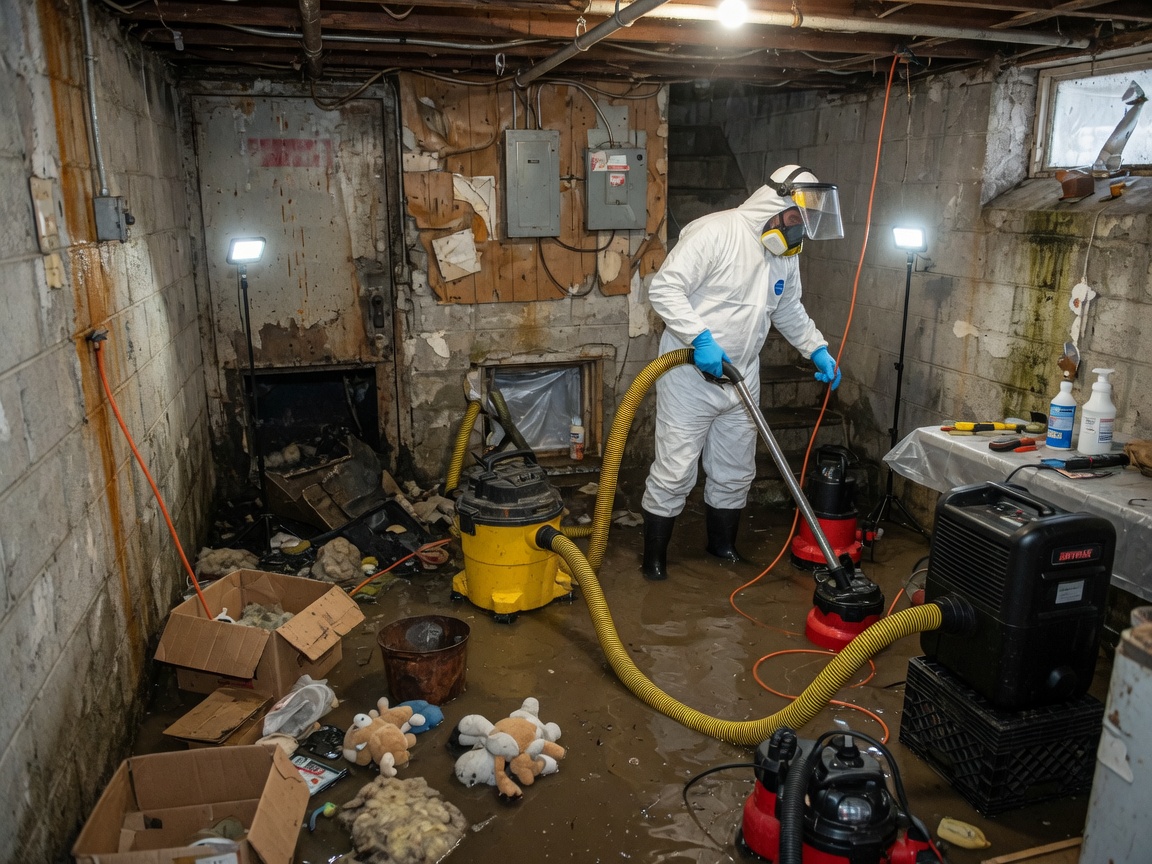
Centralia’s older housing stock in the Centralia Historic District and around Borst Park often features stone or partial basements with limited perimeter drainage. Wet winters bring repeated groundwater pressure that pushes water through mortar joints and under slabs, leaving behind silt that holds moisture against joists and subfloors. Technicians must remove saturated insulation, treat hidden mold on rim boards, and confirm that dehumidification reaches the entire crawl-space transition rather than stopping at the basement door.
Homes near Centralia College and along the rail corridor frequently sit on clay-heavy soils that drain slowly once saturated. After a storm, water can re-enter through sump pits or unsealed utility penetrations even after surface water is gone. Restoration crews use moisture meters on both sides of foundation walls and document readings before any reconstruction to satisfy Lewis County permitting requirements for structural drying.
Cleanup includes extraction of standing water, removal of affected drywall up to the moisture line, antimicrobial application on exposed framing, and placement of commercial air movers and dehumidifiers sized for the square footage. Final clearance testing checks that wood moisture content returns to the 10–12 percent range typical for Centralia’s mild summers before new finishes are installed.
Technician insight
In Centralia, the thing that catches most people out with flooded basement cleanup is clay soil that holds water against 80- to 100-year-old foundations in the Historic District long after the rain stops. Homeowners often think once the water is pumped the job is done, but we still have to chase moisture behind plaster and into rim-joist cavities that stay damp through our mild summers.
Downtown Centralia Basement After Heavy Rain
A 1920s home near Centralia College took on eight inches of groundwater through a cracked foundation during a November storm. Extraction removed the water and silt, but moisture readings stayed elevated behind the original plaster. Targeted drying and antimicrobial treatment on the rim joists brought levels down within five days, allowing the owner to finish the space without further demolition.
Flooded Basement Cleanup Services We Offer
✓Standing Water Extraction
Rapid removal of floodwater from basements in Downtown Centralia and Borst Park area homes using truck-mounted pumps sized for Lewis County rainfall events.
✓Basement Drying and Dehumidification
Placement of commercial drying equipment to pull moisture from masonry walls and soil under slabs common in Centralia’s older housing stock.
✓Silt and Mud Removal
Cleaning of fine sediment left after Chehalis River tributary flooding that settles into floor drains and wall cavities in Centralia basements.
✓Mold Prevention Treatment
Application of EPA-registered antimicrobials to framing and subfloors after wet winters to stop hidden growth in humid Centralia homes.
✓Sump Pump Failure Response
Emergency pumping and system checks when power outages during Lewis County storms allow groundwater to rise in Borst Park area basements.
Flooded Basement Cleanup Cost in Centralia, WA
| Service | Typical Range | What Affects It |
|---|---|---|
| Standing Water Extraction | $450–$900 | Depends on depth and whether mud removal is required |
| Full Basement Drying Package | $1,200–$2,400 | Includes equipment, monitoring, and disposal for typical Centralia homes |
| Silt Removal Add-On | $300–$650 | Common after winter storms in low-lying Borst Park area properties |
Ranges are typical for Centralia, WA and confirmed with an exact written quote before any work starts.
How it works
- 1
Arrival And Safety Assessment
Technicians arrive from 217 W Main St, shut off electrical hazards, and evaluate structural safety before entering flooded basements in Centralia.
- 2
Water Extraction
Standing water is pumped out and debris is removed to prevent further saturation of Centralia Historic District foundation walls.
- 3
Drying And Monitoring
Air movers and dehumidifiers run while moisture readings are tracked daily until materials reach acceptable levels for the region’s climate.
- 4
Sanitizing And Clearance
Affected surfaces receive antimicrobial treatment and final moisture verification before homeowners return to the space.
Pricing
Pricing varies with water volume, affected square footage, and how long materials have been wet.